As the digital asset industry continues to evolve, attention is increasingly shifting beyond trading and investment towards real-world utility. Crypto-funded payment cards offer a practical way to connect digital assets with familiar payment experiences, allowing users to access everyday payment services through established financial infrastructure.
Bringing Crypto into Everyday Payments
WebitPay enables eligible users to fund their accounts with supported cryptocurrencies, including USDT and USDC, and access Visa payment cards for everyday purchases.
Through its mobile application, users can manage their crypto-funded balances and payment cards in one place. The platform offers virtual cards for online transactions and physical cards for in-store purchases, with Google Pay support available for eligible cards and devices.
By combining cryptocurrency funding with established card payment infrastructure, WebitPay aims to simplify the experience of using digital assets for everyday spending.
WebitPay at TOKEN2049 Singapore
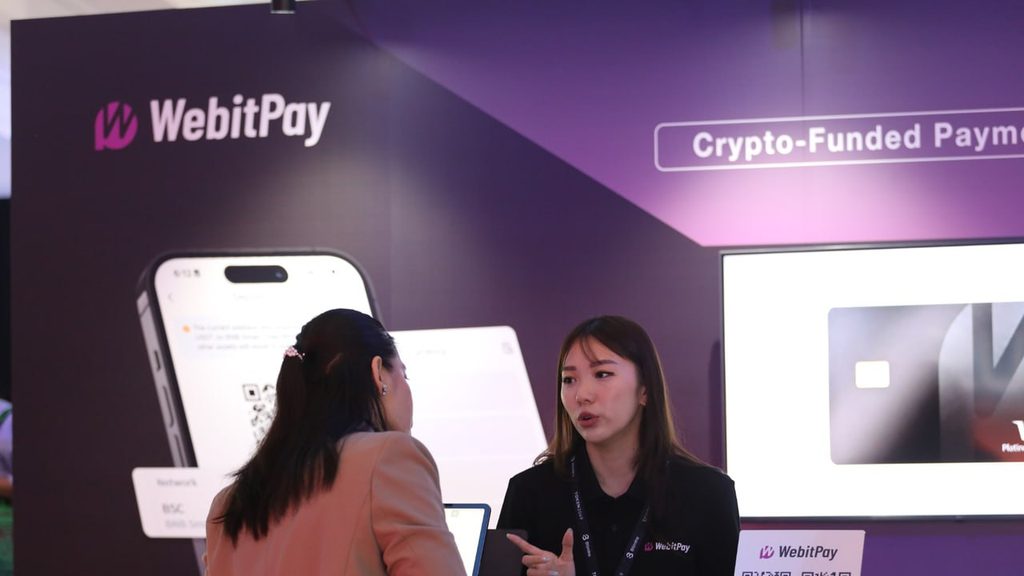
During TOKEN2049 Singapore 2026, WebitPay showcased its virtual card offering and its Webit Black physical card, introducing visitors to its approach to crypto payments under the brand message “Spend Crypto. Live Global.”
Throughout the event, WebitPay engaged with industry participants across the digital asset, fintech and payment infrastructure sectors, exchanging perspectives on the growing demand for practical crypto payment solutions.
The discussions highlighted several areas of interest for the company, including cross-border payment experiences, card issuing infrastructure and opportunities to improve the accessibility of crypto-funded payments.
For WebitPay, the exhibition represented an opportunity not only to present its products but also to strengthen its connections within the broader global payments ecosystem.
Building Towards More Accessible Crypto Payments
Following TOKEN2049 Singapore, WebitPay remains focused on improving its card payment experience and exploring additional payment capabilities.
As digital assets become increasingly integrated into mainstream financial services, WebitPay aims to make crypto-funded payments simpler and more accessible to eligible users across supported markets.
With a focus on practical utility, the company continues to work towards bridging the gap between digital asset ownership and everyday spending.
About WebitPay
WebitPay is a crypto payment platform offering cryptocurrency funding and virtual and physical Visa card solutions. Through its mobile application, WebitPay connects supported digital assets with everyday payment experiences, enabling eligible users to manage their balances and access card-based payments.
For more information, visit https://webitpay.net.
]]>This shift can already be seen across onchain markets as more assets and strategies move onchain. For instance, tokenized real-world assets (RWAs) have reached almost $40 billion, a 10x increase in just over two years, while the total stablecoin value has surpassed $300 billion.
So, as institutional capital finds its way into yield-bearing stablecoins, tokenized real-world assets, onchain credit and market-neutral strategies, the infrastructure is becoming more sophisticated, with investors just as concerned about the construction of yield opportunities, how secure they are and how to monitor where their capital is going as they are about the APY.
As Brandon Reid, Director of Business Development at Shyft, pointed out, among institutional investors, “there is more focus on where yield comes from, how it can be independently verified and what happens during extreme market volatility.”
Shyft is built to address this very shift from simply asking what a strategy can return to understanding its underlying mechanics, risks and reporting.
The yield management platform is designed to offer investors access to professionally curated onchain strategies covering crypto, real estate, gold and structured yield through self-custodial vaults. This way, Shyft is making strategies that usually require high minimums, private relationships and complicated onboarding easier to access, compare and verify for all kinds of investors.
Moreover, rather than having its users put together their individual positions across different protocols themselves, Shyft brings multiple strategies together within a unified capital allocation framework.
The platform is currently serving a retail audience while also positioning itself around the institutional side of the onchain yield market.
Its first two vaults are shCORE and shYIELD. Instead of relying on a single protocol or return source, these vaults combine different sources of yield within structured portfolios.
shYIELD is the performance-driven, multi-yield, higher-target-return strategy that combines high-frequency basis trading, private credit and curated DeFi opportunities through allocations to Radiant Prime, Maple’s syrupUSDC and Gauntlet USD Alpha.
shCORE takes a more balanced approach by blending T-Bills and controlled basis trading exposure to deliver stable and diversified returns through allocations to Radiant Prime, Ondo USDY and Sky’s sUSDS.
A new product that combines cross-chain staking, diversified real-world asset exposure and core single-asset yield strategies is also in the works.
These vaults remove the need for investors to navigate every protocol, strategy and risk individually, as Shyft brings them together within a single framework, thus providing a more structured way of allocating capital while maintaining onchain visibility into how that capital is deployed.
The underlying infrastructure of these vaults, offering access to crypto, real estate, gold and structured yield, is supplied by Ember Protocol.
The vault framework, Shyft says, uses the ERC-4626 standard, multi-role authorization, withdrawal controls, emergency timelocks, concentration limits, automated rebalancing and circuit breakers. Risks associated with onchain capital management are mitigated via smart contract audits, controls and testing across unit, integration, fuzz and invariant testing.
Furthermore, full transparency is offered via Accountable, RedStone and Chainlink PoR for off-exchange positions. This means allocators don’t have to take a manager’s word for performance; rather, they can actually check and verify it.
To bring shCORE and shYIELD to the market, Shyft has joined hands with GAP3 Partners, which is a VARA-licensed Virtual Asset Investment Advisor and acts as its Co-Curator. GAP3 provides research, analysis and recommendations around the vault strategies, adding an external investment-advisory layer to Shyft’s strategy-selection process.
It has also onboarded Blockchain Center Abu Dhabi as its Strategic Global Council, which “unites policy, institutional and vault curation expertise to accelerate Shyft’s global expansion,” the company announced on X. The government-adjacent institution advances digital asset initiatives by “connecting innovation with regulators and institutional capital in one of the world’s most ambitious markets.”
This partnership, Reid also shared, is intended to help the platform “build the right institutional relationships in the UAE.”
By targeting institutional allocations, regional partnerships and additional vault offerings, Shyft aims to expand beyond a small set of initial vaults into a broader platform for allocating capital across crypto-native and real-world financial opportunities.
At its core, what Shyft is trying to do is make onchain capital allocation less fragmented and more transparent by making the selection, combination, monitoring and accessibility of multi-yield sources possible through a structured vault-based framework.
“Onchain yield is evolving into a broader investment ecosystem, which means the next chapter of digital assets will be about creating frameworks that allow investors to access strategies in a more structured, transparent and efficient way,” said Reid.
As onchain finance continues to move toward larger and more sophisticated capital pools, Shyft is focused on bridging the gap between those strategies and the investors who want access to them without having to deal with the complex underlying infrastructure themselves, while making yield understandable, verifiable and accessible within a framework that investors can actually evaluate.
]]>Crypto markets never really close. A price move can begin while someone is at work, asleep or simply away from their screen. For people interested in crypto but unwilling to spend hours watching charts, that creates a familiar problem: how do you participate without effectively taking on a second job?
Automation offers one answer, but handing every decision to a trading bot creates another concern. Markets are influenced by news, liquidity, sentiment and unexpected events that do not always fit neatly into historical patterns.
A different model is beginning to emerge. Instead of asking whether humans or artificial intelligence should trade, some platforms are asking how the two can work together.
The case for pairing human judgment with AI
The appeal of managed trading is relatively simple. Many people want exposure to cryptocurrency markets but do not have the time, confidence or experience to make frequent trading decisions themselves.
The usual alternatives sit at opposite ends of the spectrum. An investor can manage everything personally, from research and chart analysis to entries and exits. Or they can rely heavily on automated systems designed to execute trades according to predefined signals and models.
Neither option is universally suitable.
Experienced traders can interpret unusual conditions, challenge an assumption and adjust their thinking when markets behave differently than expected. AI, meanwhile, can process far larger amounts of information than one person can realistically monitor at once.
That creates a potentially more useful division of labor. AI can organize market data, analyze news, examine performance and highlight risk signals. A professional trader can then decide what, if anything, should actually be done.
Arbitflow is built around this human-plus-AI structure. Professional traders remain responsible for trading decisions, while proprietary AI is intended to assist with market analysis, news monitoring, performance assessment and risk identification.
That distinction matters. The goal is not to remove people from the process. It is to give them another analytical layer.
Dropping leverage removes one risk, not all of them
How trades are executed matters just as much as who makes the decision.
Leverage is common across crypto derivatives markets because it lets traders control positions worth more than the capital they initially commit. The same mechanism can also magnify losses. If the market moves far enough against a leveraged position, an exchange may forcibly liquidate it.
Spot trading works differently. Traders buy and sell the underlying cryptocurrency without borrowing additional capital to enlarge the position.
That does not make spot trading safe. Bitcoin, Ether and smaller digital assets can still lose substantial value. Poor entries can still produce losses, professional traders can still make incorrect decisions and prolonged bear markets can affect almost any portfolio.
What disappears is one specific source of risk: forced liquidation caused by leverage.
This is why a spot-only approach can make sense for a managed trading service aimed at people who may not be experienced traders themselves. It keeps the strategy exposed to normal market movements without adding another layer of leverage-related complexity.
For anyone evaluating a managed crypto service, this distinction is worth understanding. “Lower structural risk” is not the same thing as “low risk,” and avoiding leverage cannot guarantee positive returns.
Treating AI as an analyst, not an autopilot
AI in trading is often marketed around autonomy. The assumption is that a sufficiently sophisticated system should eventually identify opportunities, make decisions and execute trades largely on its own.
There is another use case that receives less attention: decision support.
A human trader operating in a 24-hour global market faces an information problem. Prices are changing across many assets while economic announcements, regulatory developments, exchange activity and crypto-specific news can arrive simultaneously.
AI systems can help reduce that information burden.
A model might identify an unusual price move, compare it with historical behavior, scan related news and flag a change in a trader’s recent performance. None of those outputs necessarily needs to become a trade automatically.
Instead, they can become inputs for someone who understands the strategy and remains accountable for the final decision.
According to its public materials, Arbitflow’s AI infrastructure was developed around trading workflows following market research and strategy development that began in 2023. The platform says its system analyzes both market information and trader behavior rather than replacing its traders outright.
Public coverage of the service describes the same model, with AI used to process market movements, news and performance data while human traders retain control over decisions.
That may be a more realistic way to think about AI in markets. Its advantage is not necessarily predicting the future perfectly. It is helping humans process more information consistently and potentially notice risks earlier.
Delegating trading decisions creates another question: how much confidence should a user place in one trader?
Every trader has strengths and weaknesses. A strategy that performs well in a trending market may struggle when prices move sideways. Another trader may be more conservative but miss opportunities during strong momentum.
Spreading capital across multiple vetted traders
One possible response is diversification.
The platform allows capital to be distributed among several traders instead of requiring users to depend on a single strategy. It also says traders go through identity verification, professional-history checks and simulated skills testing before being accepted, followed by ongoing performance monitoring.
Users can reportedly review trader history and see most trading activity through a Live Trading feature. Entry starts from $25, which lowers the amount needed to experiment with this type of managed approach. Similar coverage has reported the same minimum and multi-trader allocation model.
Those features still require scrutiny. A trader’s past results do not guarantee future performance, and users should understand how performance statistics are calculated, what fees apply, how funds are handled and what happens during losing periods.
Diversification can reduce dependence on one trader, but it cannot eliminate market-wide losses.
It’s not humans vs. machines; It’s how they’re combined
The debate around AI trading can easily become a contest between humans and machines. Crypto markets may make that framing especially tempting because they operate continuously and generate enormous quantities of data.
But the more practical question may be simpler: which tasks are humans good at, and which tasks are machines better equipped to handle?
AI can scan, compare and monitor at a scale that would be exhausting for an individual trader. Experienced people can bring judgment, skepticism and context to information that does not always fit a model cleanly.
Combining those capabilities while restricting activity to spot markets represents one way of approaching hands-off crypto participation without moving immediately toward full automation or leveraged speculation.
It is still trading, and trading still involves risk. The interesting part of the model is not a promise that AI can eliminate that uncertainty. It is the decision to use AI as an assistant while leaving the final call with professional traders.
]]>Grvt kicked off its “Paid Mode, On” campaign on September 21, offering traders payments when a resting limit order on an eligible RWA pair gets filled during the three-month campaign that runs until December 21.
The campaign covers trades on any of the 100+ tokenized equities, commodities, regional ETFs, and private company markets, such as SpaceX, OpenAI, and Anthropic, that Grvt offers.
How does the Grvt rebate campaign work?
While the “−1bps rebate” tagline on Grvt’s campaign immediately appears attractive because of the 100X improvement on the platform’s standard entry-tier rebate, anyone interested in participating needs to note that certain guardrails still apply:
- Scope: The Grvt rebate campaign only applies to RWA trading markets. Crypto perps trading on the platform will continue to run on its standard fee schedule.
- Eligibility: The campaign is open exclusively to retail accounts. The campaign will not even appear in the app interface for users running institutional accounts, VIP accounts, or a negotiated market-maker agreement.
Accounts that are reclassified as institutional or VIP during the campaign period immediately become ineligible for new rebate payments.
Accounts that are already on fee tiers with better rates than the −1bps rebate the campaign offers remain at their current tier. They are never downgraded.
- Traders don’t need to manually claim their payouts. Rewards are credited directly into users’ trading accounts on every eligible fill.
- Every account linked to the same IP, device fingerprint, or showing “coordinated” trading patterns will be treated as a single entity, and all their earned rebates is subject to review.
- Wash trades, self-matched trades, or volume-generating trades flagged by Grvt do not qualify for rebates. Any rebates paid to accounts flagged in non-genuine trading activities could also be clawed back, subject to a review.
Grvt added that it reserves the right to shorten, pause, or end the campaign early “in response to unusual market activity or a system issue,” with notice where possible.
How does Grvt’s rebate payment compare across the industry?
Even before Grvt launched its three-month rebate campaign, the platform’s standard rate is already an exception among trading platforms.
The campaign multiplies Grvt’s Level 1 −0.0001% baseline rebate, which has no volume requirement, by roughly 100x to −0.01%.
In essence, two $100,000 maker fills that would normally earn $0.20 now net $20.
Other venues, on the other hand, only extend negative fee rates to accounts operating at the top of the volume ladder:
- On Hyperliquid, rates only turn negative for accounts that supply over 0.5% of total exchange-wide maker volume across a rolling 14-day window
- dYdX users have to do $100 million in volume over 30 days, with its best rate (−0.011%) reserved for $200 million-plus.
- Aster and Lighter’s standard accounts don’t pay a rebate at all. Their maker fee simply floors at zero.
Grvt is moving to leverage competitive advantage
Grvt’s rebate campaign lands as a play to ride the boom on an asset class that’s reportedly already clearing over $200 billion in monthly volume across the industry. The accompanying RWA order book and maker activity boosts are exactly the kind of usage metrics that enhance a platform’s reputation.
Grvt raised $19M in a Series A led by ZKsync roughly a year ago on a privacy-first pitch aimed at Hyperliquid’s dominance.
The platform’s native GRVT token is trading around $0.188, a few months removed from the late-July all-time high it set at $0.4615. Market cap sits near $21.5M against a $188M fully diluted value, with only about 11% of the 1 billion token supply circulating.
]]>Organized by DSA in collaboration with The Hillsdalian, the interactive session brought together participants for a discussion about personal finance, financial systems, emerging technologies, and the changing tools people use to manage money in their everyday lives.
The focus group was designed to gather qualitative insights for DSA’s ongoing longitudinal research into financial literacy and to help inform weekly publications in The Hillsdalian. As financial systems increasingly incorporate digital technologies, the session examined how individuals understand and navigate both traditional financial concepts and newer tools, including mobile banking, payment applications, automated financial platforms, and digital assets.
The discussion explored participants’ experiences with financial literacy education; approaches to planning, saving, and budgeting; credit, debt, and traditional banking; investing and long-term wealth building; and the growing role of technology in everyday financial decision-making. Participants also discussed their familiarity with digital assets, stablecoins, and decentralized finance, as well as their current and future financial concerns.
Throughout the session, participants shared how they learn about financial products, which tools they rely on, where they encounter uncertainty, and how changes in technology are influencing their financial habits. The conversation also provided an opportunity to identify areas where existing financial education frameworks may not fully reflect the ways consumers now interact with an increasingly digital financial system.
“People are paying bills on their phones, sending money through apps, and getting financial advice from social media,” said Molly Woodman, Senior Policy Advisor at DSA. “Financial education has to catch up to that. We need to hear how people are actually handling their money, including what’s working, what’s confusing, and where technology is helping or getting in the way.”
The session was led by DSA Senior Policy Advisor Molly Woodman, Content Manager Emily Ekshian, and Policy Associate Maghan Lusk. Following the formal discussion, the DSA team remained available to answer additional participant questions.
Through initiatives such as the Financial Literacy in a Changing Economy focus group, DSA remains committed to advancing research and education that reflects how individuals engage with modern financial systems, helping inform discussions around financial literacy, emerging technology, responsible innovation, and digital sovereignty.
About the Digital Sovereignty Alliance
The Digital Sovereignty Alliance (DSA) is a nonprofit social welfare organization committed to advocating for public policies that support ethical innovation in decentralized technologies, blockchain, cryptocurrency, Web3, and artificial intelligence. DSA conducts research, organizes educational events, and promotes policies that prioritize public welfare and digital sovereignty.
Media contact
Maghan Lusk
]]>Stuttgart, Germany, September 21, 2026 – CoinsBee, a global platform that makes it easy to use cryptocurrency for everyday purchases, today announced that USDT (TRC-20) on the TRON network has become the most-used onchain token and network payment option on CoinsBee, according to payment data from the global crypto gift card platform.
Over the 90-day period ending September 1, 2026, USDT on TRON recorded approximately 1.8 times as many payments on CoinsBee as Bitcoin and 1.9 times as many as Ethereum.
Its share of payment activity has also substantially increased. USDT on TRON accounted for 16.23% of all payments on CoinsBee in 2026 to date, compared with 9.92% in 2025. This represents a 64% increase in its share of total payments.
The data provides insight into how cryptocurrency holders use digital assets for everyday retail purchases, in addition to trading and investing. CoinsBee allows customers in more than 180 countries to purchase gift cards, payment cards, gaming credits and mobile top-ups from more than 5,000 global and local brands using over 200 cryptocurrencies.
USDT on TRON is also responsible for a large share of USDT spending on the platform. Over the past 90 days, TRC20 accounted for 44.6% of USDT payments on CoinsBee but 64.5% of USDT turnover. This indicates that the average value of USDT purchases made through TRON was higher than purchases made through other networks that support USDT.
In the United States, the most purchased brands using USDT on TRON during the same period included Amazon, Apple, AT&T, PlayStation, Uber, Macy’s, T-Mobile, Walmart, Sephora and DoorDash. The purchases covered categories including retail, mobile connectivity, gaming, transport and food delivery.
These findings are based on CoinsBee payment data. The 90-day analysis covers the period from June 4 through September 1, 2026, and includes successfully paid and delivered orders. It compares payments by cryptocurrency and blockchain network. Payment counts represent completed payments rather than transaction value, while turnover represents the value of the corresponding purchases on CoinsBee. The comparison of payment share uses 2026 data to date and full year 2025 data. Payment share represents each token and network combination as a percentage of total completed payments on CoinsBee during the respective period.
With this momentum, CoinsBee and TRON DAO are launching a joint campaign focused on the use of USDT on TRON for everyday purchases.
From September 21 through October 5, 2026, CoinsBee will offer eligible users of the CoinsBee mobile app a 2% discount on purchases paid with USDT on TRON. Users can enter the code USDT-TRC in the CoinsBee app and select USDT on TRON as their payment method to activate the discount. This offer is available once per user. Subject to conditions. Full campaign terms and eligibility requirements are available on the CoinsBee website.
“USDT on TRON is already the most used onchain payment option on CoinsBee, and its share of payments has grown considerably over the past year,” said Iván Escamilla Rodriguez, Product and Growth Lead at CoinsBee. “What is particularly interesting for us is that this activity translates into purchases across categories such as retail, mobile services, gaming and food delivery. Our payment data gives us a direct view into how people use stablecoins when they want to spend their assets.”
“Stablecoins become more useful when people can use them for products and services they already purchase,” said Sam Elfarra, Community Spokesperson at TRON DAO. “TRON provides infrastructure for USDT transactions at global scale, and the collaboration with CoinsBee gives users another way to use USDT for everyday purchases.”
The campaign highlights the growing use of USDT on TRON with CoinsBee’s catalog of more than 5,000 global and local brands. CoinsBee serves more than 500,000 customers and supports cryptocurrency payments for gift cards and digital products across ecommerce, gaming, entertainment, travel, food, fashion, mobile services and other categories.
About CoinsBee
CoinsBee is a global platform that makes it easy to use cryptocurrency for everyday purchases. Founded in 2019, CoinsBee enables customers to buy gift cards, payment cards, gaming credits, and mobile top-ups using more than 200 cryptocurrencies.
Available in over 180 countries, CoinsBee serves more than 500,000 customers and provides access to gift cards and digital products from more than 5,000 global and local brands across categories including e-commerce, gaming, entertainment, travel, food, fashion, and more.
By connecting cryptocurrencies with products and services people use every day, CoinsBee helps make digital assets practical beyond trading and investing. The platform continues to expand its global reach, supported cryptocurrencies, and brand selection to make spending crypto simple, fast, and accessible.
Media Contact
Erik Rossol
About TRON DAO
TRON DAO is a community-governed DAO dedicated to accelerating the decentralization of the internet via blockchain technology and dApps.
Founded in September 2017, the TRON blockchain has experienced significant growth since its MainNet launch in May 2018. Today, TRON hosts the largest circulating supply of USD Tether (USDT) stablecoin, which currently exceeds $94 billion. As of September 2026, the TRON blockchain has recorded over 405 million in total user accounts, more than 15 billion in total transactions, and over $28 billion in total value locked (TVL), based on TRONSCAN. Recognized as the global settlement layer for stablecoin transactions and everyday purchases with proven success, TRON is “Moving Trillions, Empowering Billions.”
TRONNetwork | TRONDAO | X | YouTube | Telegram | Discord | Reddit | GitHub | Medium | Forum
Media Contact
Yeweon Park
]]>Just five months after its launch, B.AI has already set a new industry record with a daily throughput of over 1.51 trillion tokens—a 71,500x-plus increase since inception.
B.AI achieved in just over 100 days what took OpenRouter, an early aggregation pioneer, roughly two years. Driven by the integration of settlement networks with core infrastructure, the exponential growth pulled off by B.AI highlights the viability of its full-stack commercial strategy while also demonstrating to the global market that the platform has risen to be the absolute leader in the next-generation AI infrastructure stack.
B.AI has secured its leadership thanks largely to its ability to capture and cater to the global demand for cost-effective, high-performance Chinese LLMs. While offering homegrown LLM products a critical gateway for international adoption, the platform has also gained a head start by positioning itself as a global compute distribution hub. B.AI’s ability to rise in this tailwind is rooted in its unique ecosystem design.
Co-incubated by TRON and YZi Labs, B.AI disrupts the market via a dual engine of settlement and distribution, plus its complete infrastructure for the emerging agent economy. The platform enables global access to top-tier LLM compute while equipping AI agents with native resource scheduling and execution capabilities—unlocking liquidity and value exchange across the global agent economy.
Unprecedented Infrastructure Growth: B.AI Builds Global Distribution Hub for LLMs
To reach 1.51 trillion tokens in its daily throughput, simply seizing the tailwind is far from enough. B.AI has also responded swiftly to two macro trends in the AI industry: the cost-performance advantage of leading Chinese LLMs and the surging demand for high-throughput, low-cost inference in the agentic era.
Over the past year, Chinese LLM developers like DeepSeek, Kimi, Qwen, and GLM have matched top global benchmarks at a fraction of the API cost. This unbeatable cost efficiency makes adoption virtually inevitable for developers worldwide.
As a global, next-generation infrastructure, B.AI aggregates top international models like GPT and Claude alongside rising Chinese LLMs. The platform has established close partnerships with Tencent, Alibaba, ByteDance, DeepSeek, Zhipu AI, Kimi, and MiniMax—all top LLM players in the Chinese market—to build a comprehensive model portfolio. This all-star model lineup has, in turn, made B.AI the default launchpad for Chinese LLMs seeking global expansion.
Chinese LLMs, including DeepSeek-V4-Flash, Qwen3.8-Flash, and GLM-5.3 Flash, have stood out as top-performing models on B.AI with the highest usage. Building on the momentum, B.AI continues to drive adoption through model discounts, limited-time free access, tiered API pricing (with discounts up to 90%), and developer incentives, aiming to convert model cost efficiencies into usable throughput for developers worldwide. The traction from this strategic positioning is clearly backed by the numbers: B.AI’s daily token throughput has breached 1.51 trillion—a massive 71,500x-plus surge since its first day upon launch.
Beyond its organic growth momentum, ecosystem partner YZi Labs serves as B.AI’s core distribution engine, continuously onboarding early-stage projects and developer communities. This ecosystem support enables B.AI to penetrate diverse real-world use cases, driving a steady influx of incremental traffic and commercial demand.
For foundation model providers, B.AI’s multi-trillion, high-concurrency architecture provides a fast track to high-value global workloads. Within this massive pool of demand, B.AI has evolved from a simple distribution channel into a primary facilitator—scaling the commercial reach of leading LLMs while reshaping the global AI landscape.
Beyond Aggregation and Routing: B.AI Builds Closed-Loop Infrastructure for the Agent Economy
Yet for this super amplifier to truly sustain a trillion-dollar agent economy, front-end compute routing is nowhere near enough. Building on the API aggregation foundation pioneered by early movers like OpenRouter, B.AI recognized a critical insight: fully unlocking massive agent collaboration requires a closed financial loop at the foundational layer.
To achieve this, B.AI bridges models and agents, creating a global settlement layer for intelligence. This core differentiator transforms the platform from a simple traffic conduit into the central master ledger for the entire agent economy, ensuring every cross-region call and task allocation is seamlessly routed, precisely metered, and automatically settled.
To achieve this vision, B.AI embeds settlement directly into the infrastructure layer, creating a dual-track Web2 and Web3 payment network. Built on Web3 principles, the architecture maintains backward compatibility with traditional Web2 payment systems. On the Web3 front, B.AI leverages on-chain settlement channels to provide global developers with decentralized, verifiable, and low-friction options that enable fully automated transactions and micropayments between agents. On the Web2 front, it preserves legacy gateways like WeChat Pay, Alipay, UnionPay, and Visa, ensuring effortless integration into existing enterprise workflows. Together, this dual-track model delivers a single integration point for frictionless global capital flow.
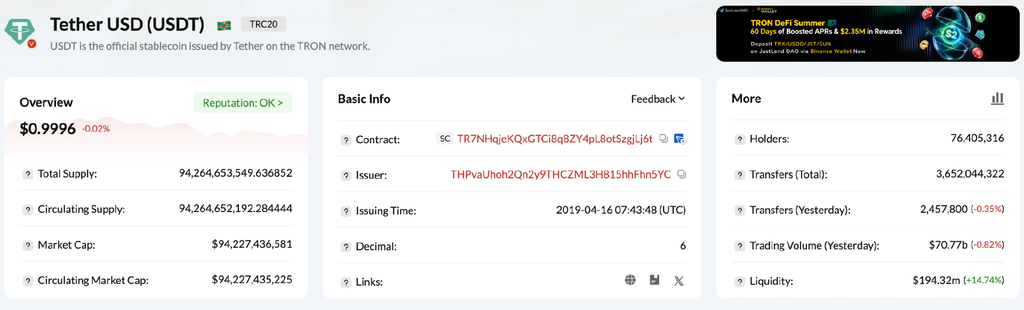
At the heart of this global liquidity is B.AI’s deep integration with TRON. As the world’s largest stablecoin transfer network, TRON offers B.AI a native payment rail through its massive USDT ecosystem, built for maximum liquidity and minimal friction. As of September 10, total TRC-20 USDT supply surpassed 94.2 billion, continuing to set record highs. Backed by TRON’s battle-tested on-chain capacity, B.AI provides the essential infrastructure required to scale cross-border compute scheduling and high-frequency automated agent micro-transactions.
The true ambition of this architecture is to capture the emerging landscape of automated transactions in the agent economy ahead of the pack. The coming explosion in agent adoption will inevitably drive agent-to-agent (A2A) collaboration and autonomous commerce. Yet, fully unlocking this automated A2A synergy requires far more than just a foundational payment rail. B.AI builds beyond its Web3 smart settlement network by deploying a dedicated full-stack runtime environment for agents. This establishes an end-to-end, high-precision technical loop bridging compute scheduling, task execution, and financial settlement.
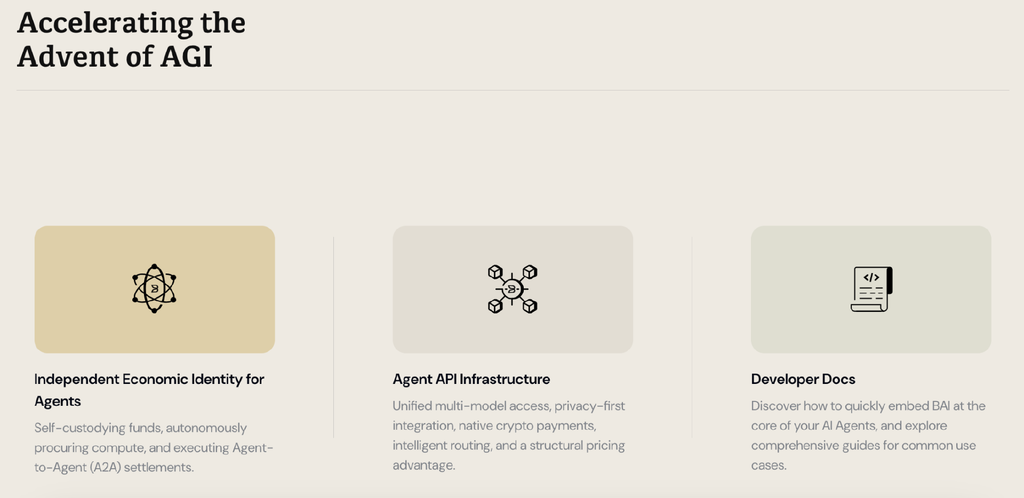
At the scheduling layer, B.AI drives fine-grained compute allocation. Its tiered API system fundamentally reshapes compute procurement logic, offering structured invocation plans that allow developers to match specific business demands with optimal compute resources.
At the execution layer, B.AI constructs a native agent collaboration ecosystem. It endows agents with direct operational capabilities to act across the digital world. Powered by embedded toolchains like Skills and Agent Wallet, alongside natively integrated AI assistants BAIclaw and BAI code, agents evolve into fully fledged digital workers capable of autonomous data acquisition and execution, laying a solid engineering foundation for multi-agent synergy.
At the protocol layer, B.AI establishes foundational transaction standards for A2A commerce. This marks B.AI’s most strategically profound move. By natively integrating the x402 payment protocol and the 8004 identity authentication protocol, the platform paves a standardized path for mutual trust, identity verification, and high-frequency automated settlement between agents.
From fine-grained model scheduling to intelligent collaboration systems and standardized transaction protocols, this architecture seamlessly fuses perception, reasoning, action, and settlement. This holistic infrastructure propels B.AI into a central hub for the agent economy, engineered to handle micro-transactions and compute settlement at scale. Crossing into the trillion-token era is merely a new starting point for B.AI. As next-generation AI infrastructure, its core value extends beyond distributing intelligence to powering transactions. By establishing foundational standards for high-frequency A2A collaboration, B.AI is reshaping the global flow of compute value, driving AI infrastructure into a new era built explicitly for agents and machine intelligence.
B.AI Team
Singapore
]]>Through the integration, Ducat users can use USDT as a primary settlement asset and access wUNIT, the TRC-20 representation of Ducat’s Bitcoin-backed dollar, UNIT, on the TRON network. UNIT remains issued against BTC on Bitcoin, while wUNIT enables that value to move across TRON and interact with USDT liquidity. Users can hold wUNIT or swap it directly for USDT through a dedicated stablecoin liquidity pool, while liquidity providers can supply both assets and receive a share of swap fees generated by the pool.
The integration connects Ducat’s Bitcoin-native credit engine with TRON’s stablecoin network while keeping Ducat’s underlying collateral and issuance on Bitcoin. The architecture cleanly separates the roles of each layer: Bitcoin provides the underlying value and collateral, Ducat manages the monetary and credit logic, and TRON provides the scalable settlement environment. This gives Bitcoin-backed liquidity a direct route into TRON’s stablecoin ecosystem, supporting payments, capital movement, and other on-chain financial workflows.
“Ducat brings Bitcoin-backed value into TRON’s robust stablecoin ecosystem, which already has more than $94 billion in circulating USDT” said Sam Elfarra, Community Spokesperson at TRON DAO. “TRON users gain access to another digital dollar, while Bitcoin holders gain more ways to put their liquidity to work across the network.”
“UNIT was designed to let Bitcoin holders access dollar liquidity without handing their BTC to a custodian,” said David Evans, CEO of Ducat. “The TRON integration turns that model into something people can use across one of crypto’s largest stablecoin networks. wUNIT will arrive as a TRC-20 token, swap directly against USDT, and move back to Bitcoin through the same bridge. The integration can put Bitcoin-backed credit into the flow of stablecoins people already use every day.”
The integration reflects a shared focus between Ducat and TRON on expanding stablecoin utility beyond trading-driven activity. By combining Bitcoin-backed value, Ducat’s monetary infrastructure, and TRON’s scalable settlement network, the integration connects Bitcoin-backed credit with a stablecoin ecosystem built to support payments, liquidity, and broader financial activity at scale.
About Ducat
Ducat is a Bitcoin Layer 1 credit and stablecoin protocol that lets Bitcoin holders borrow dollars against BTC without handing their assets to a third-party custodian. Its credit stack is built and enforced on Bitcoin. Ducat is backed by Hivemind and CMS and is an incubatee of CMC Labs. It built the first Bitcoin-native oracle with Chainlink.
Media Contact
Ducat Communications
About TRON DAO
TRON DAO is a community-governed DAO dedicated to accelerating the decentralization of the internet via blockchain technology and dApps.
Founded in September 2017, the TRON blockchain has experienced significant growth since its MainNet launch in May 2018. Today, TRON hosts the largest circulating supply of USD Tether (USDT) stablecoin, which currently exceeds $94 billion. As of September 2026, the TRON blockchain has recorded over 404 million in total user accounts, more than 15 billion in total transactions, and over $27 billion in total value locked (TVL), based on TRONSCAN. Recognized as the global settlement layer for stablecoin transactions and everyday purchases with proven success, TRON is “Moving Trillions, Empowering Billions.”
TRONNetwork | TRONDAO | X | YouTube | Telegram | Discord | Reddit | GitHub | Medium | Forum
Media Contact
Yeweon Park
]]>The first list of Justin Sun Prize winners was also announced, recognizing solutions and formalized proofs involving 66 mathematical problems. The top prize, worth US$1 million, was awarded to the OpenAI research team in recognition of its solution and formalized proof for the Existence and Smoothness of the Three-Dimensional Navier–Stokes Equations problem. According to information published by OpenAI, the relevant proof was produced by its internal model, and the Lean formalization and verification were completed by GPT‑6 Astra.
This problem concerns the Navier–Stokes equations, which describe the motion of fluids and are commonly abbreviated as the N–S equations. The equations were developed in the 19th century by French physicist Claude-Louis Navier, Irish-born British mathematician George Gabriel Stokes, and others, and have a history of approximately two hundred years. In 2000, the Clay Mathematics Institute listed the Navier–Stokes Existence and Smoothness problem as one of the seven Millennium Prize Problems and offered a US$1 million reward for its solution.
The Justin Sun Prize does not use traditional nominations or credential thresholds as barriers to entry, nor does it operate on a four-year cycle or the rhythm of lifetime achievement. Instead, it ties the prize directly to mathematical problems and machine-verifiable formalized proofs. Anyone can receive the prize as long as they are the first to achieve a qualifying breakthrough.
The vision of the Justin Sun Prize is to become the “Nobel Prize of the AI Era,” responding to the profound transformation of scientific research and incentives in the new era in a more decentralized, formalized, and machine-driven way. The repository of mathematical problems and formalized code will be maintained and publicly updated on an ongoing basis. Once a problem is listed, it is locked in: problems can be added only, never removed; awarded prize funds do not need to be returned under any circumstances.
The current problem list already includes formal verification of the Poincaré Conjecture, the Riemann Hypothesis, Goldbach’s Conjecture, and a large number of unsolved problems proposed during the lifetime of the late mathematician and Wolf Prize laureate Paul Erdős.
In addition to the prize, winners will also receive a certificate and a medal. The edge of the medal is inscribed with the Latin phrase “Quod probatur, solvitur,” meaning “Proved, then paid.”
The Justin Sun Prize adheres to three core principles: openness, public benefit, and open source. It is open to all eligible contributors, with no restrictions based on nationality, institution, or identity, and makes no distinction between humans and AI; funds are used exclusively for prize awards and open initiatives and are not intended for profit; the problem list, confirmation standards, proofs, and verification materials are all made available to the public through GitHub, while prize disbursement records are recorded on-chain for permanent traceability and immutability.
“An award named after a person is the least political thing in the world,” said Sun. “More importantly, it gives me an answer to myself—my wealth is rooted in mathematics. It came from mathematics, and it will return to mathematics.”
According to public records, Sun has donated more than US$45 million across technology, environmental protection, disaster relief, and other fields. The Justin Sun Prize will become a central focus of Sun’s philanthropic efforts, continuing to support breakthroughs in fundamental science through an open and verifiable model.
The prize will be paid out in either USDT on TRON (TRC-20) or USDC on Ethereum (ERC-20) based on the recipient’s choice. For more information, please visit www.hejustinsun.com/prize.
About the Office of Justin Sun
The Office of Justin Sun supports Justin Sun’s global business, philanthropic and public initiatives across technology, blockchain, artificial intelligence, scientific research, investment, art and space exploration.
Justin Sun is the Ambassador and former Permanent Representative of Grenada to the World Trade Organization and the Founder of TRON. TRON is the leading blockchain for the stablecoin revolution, processing over $13 trillion in volume since its inception. In the world’s emerging markets, people rely on USDT on TRON to access the global financial system.
A protégé of Alibaba founder Jack Ma, Sun has been recognized internationally for his work in the digital asset industry, including a Forbes cover profile in April 2025 and multiple appearances on the Forbes 30 Under 30 list. In August 2025, he flew aboard Blue Origin’s NS-34 mission, becoming the 712th person in history to travel to space. His broader interests span technology, investment, philanthropy, art, gaming, and space exploration.
Office of Justin Sun Contact:
About Justin Sun Prize
The Justin Sun Prize is an academic initiative established by Justin Sun to support advances in mathematics, formal verification, and AI-assisted scientific discovery. The prize is decentralized and built around the principle that mathematical work should be judged by the strength, rigor, and verifiability of the proof itself, not the prestige or reputation of those submitting it.
Justin Sun established the prize in his own name as a long-term commitment to return wealth created through mathematics and technology back to mathematics itself. Its legacy is intended to be defined by the body of work it recognizes and the laureates whose discoveries stand the test of time. The prize links clearly defined mathematical challenges to machine-verifiable proof. Its guiding principles are openness, public benefit and open-source access.
Visit https://www.hejustinsun.com/prize for more information.
Contact:
]]>The forum brought together leaders from across traditional finance, digital assets, technology, and policy to examine the infrastructure, market structure, and regulatory considerations shaping the continued convergence of traditional and digital financial markets.
Wall moderated “The Infrastructure Layer” panel, which featured Stephen Gardner, Co-President of Zerohash; Edward Nasti, Vice President and Head of Legal at Alpaca; and Austin Reid, Global Head of Revenue and Business at FalconX. The panel explored the infrastructure required to support growing institutional participation in digital assets, including compliance, access to global liquidity, stablecoins, tokenization, and evolving regulatory requirements across jurisdictions.
The discussion focused on how growing specialization across trading, custody, liquidity, settlement, and compliance is increasing the importance of interoperability, operational resilience, and capital efficiency for institutional adoption. Participants highlighted the increased emphasis on asset segregation, proof of reserves, counterparty resilience, and regulatory coverage in institutional due diligence, alongside the increasing integration of compliance requirements directly into digital asset infrastructure.
The conversation also addressed the expanding role of banks in stablecoins and tokenized assets, the potential for greater market consolidation, and the need for clearer regulatory coordination, including guidance from the U.S. Securities and Exchange Commission (SEC) and the Commodity Futures Trading Commission (CFTC), as well as the CLARITY Act, to support continued institutional participation and product development.
“Digital asset infrastructure is entering an institutional phase, where scale depends on more than technology alone,” said Adrian Wall, Managing Director of DSA. “Compliance, interoperability, and regulatory coordination will determine whether stablecoins, tokenized assets, and global liquidity can develop into trusted financial infrastructure supported by clear, workable policy frameworks.”
Through its participation in The Digital Chamber’s Convergence Forum in New York City, DSA remains committed to advancing research, stakeholder engagement, and policy discussions that support responsible innovation, strengthen digital sovereignty, and contribute to the development of secure and inclusive digital financial infrastructure.
About the Digital Sovereignty Alliance
The Digital Sovereignty Alliance (DSA) is a nonprofit social welfare organization committed to advocating for public policies that support ethical innovation in decentralized technologies, blockchain, cryptocurrency, Web3, and artificial intelligence. DSA conducts research, organizes educational events, and promotes policies that prioritize public welfare and digital sovereignty.
Media contact
Maghan Lusk
]]>