Justin Sun Highlights Vision for a Unified Financial System
Justin Sun, Founder of TRON, took the Main Stage to deliver a keynote titled “Building the Rails for a Unified Financial System.” In his address, Sun outlined TRON’s role as a foundational settlement layer for the global digital economy, highlighting the growth of TRON as ideal infrastructure for supporting Agentic AI payments. He also emphasized that collaboration across the industry, spanning traditional finance and emerging technologies, is essential to building a unified, interoperable, and more resilient digital asset ecosystem.
“In markets like the US, where financial infrastructure is already strong and well established, blockchain and AI can help expand that system into a more open and programmable digital environment,” said Sun. “As we look ahead, the most important challenge is building the infrastructure that allows all parts of the financial system to work together. A unified financial system will combine the strengths of traditional finance with the openness and efficiency of blockchain networks.”
TRON DAO Advances Policy Dialogue
In addition to Sun’s keynote, Adrian Wall, Senior Director of U.S. Policy at TRON DAO, moderated a Main Stage session titled “CLARITY: What It Took and What Comes Next.” The discussion explored key legislative milestones and regulatory developments shaping the digital asset landscape in the United States. Wall was joined by Dusty Johnson, U.S. Representative for South Dakota (R-SD).
Across both days of the summit, TRON DAO hosted a dedicated VIP Lounge at Capital Turnaround, serving as a central hub for industry leaders, policymakers, and community members. The lounge created a space for meaningful conversations around TRON’s latest ecosystem developments, ongoing policy initiatives, and the evolving regulatory landscape, reinforcing TRON DAO’s commitment to fostering collaboration beyond the conference stage.
TRON DAO’s participation in the DC Blockchain Summit highlights its continued dedication to responsible blockchain innovation and constructive engagement with policymakers. As global regulatory discussions evolve, TRON DAO remains focused on working alongside governments, industry leaders, and institutions to help advance a more open, accessible, and secure financial system.
About TRON DAO
TRON DAO is a community-governed DAO dedicated to accelerating the decentralization of the internet via blockchain technology and dApps,
Founded in September 2017 by H.E. Justin Sun, the TRON blockchain has experienced significant growth since its MainNet launch in May 2018. Until recently, TRON hosted the largest circulating supply of USD Tether (USDT) stablecoin, which currently exceeds $86 billion. As of March 2026, the TRON blockchain has recorded over 371 million in total user accounts, more than 13 billion in total transactions, and over $24 billion in total value locked (TVL), based on TRONSCAN. Recognized as the global settlement layer for stablecoin transactions and everyday purchases with proven success, TRON is “Moving Trillions, Empowering Billions.”
TRONNetwork | TRONDAO | X | YouTube | Telegram | Discord | Reddit | GitHub | Medium | Forum
Media Contact
Yeweon Park
]]>BingX AI Claw is the latest addition to the BingX AI suite of intelligence, joining BingX AI Master, BingX AI Bingo, and BingX AI Skills Hub. Consistent with the broader BingX AI suite, BingX AI Claw will be available to traders in-app free of charge, supporting BingX’s commitment to making digital asset trading more accessible while equipping users with the insights and tools needed to navigate markets with greater confidence.
BingX AI Claw instantly generates actionable trading signals and insights for users navigating increasingly complex markets, without the need for complicated configurations or long setup times:
- Cross-Validated Signals: BingX AI Claw analyzes technical indicators, capital flows, news developments, and market sentiment across multiple dimensions, generating signals validated across multiple data sources to improve reliability.
- Real-Time Strategy Optimization: The system dynamically adapts insights and signals to trading parameters and analytical models as market conditions change, ensuring they remain up to date and actionable in the current trading environment.
- Self-Evolving Intelligence: By continuously learning from trading outcomes and market behavior, BingX AI Claw refines its own analytical models over time to improve the accuracy and responsiveness of signals and insights provided to users.
- Explainable Insights: Every signal can be questioned, and BingX AI Claw responds with clear and accessible reasoning, allowing traders to understand the underlying logic behind the analysis rather than relying on opaque recommendations.
- Full User Control: BingX AI Claw delivers trading insights and signals without automatically executing trades, ensuring users remain fully in control of their decisions and strategies.
“BingX AI Claw is the next major step forward in our mission as the first all-in-AI exchange to make trading more accessible to everyone,” said Vivien Lin, Chief Product Officer at BingX. “By expanding on our portfolio of AI agents with BingX AI Claw’s multi-asset trading signals, we are delivering a new generation of trading intelligence that both lowers barriers to entry and helps traders identify high-potential opportunities while maintaining full control of their decisions and strategies.”
About BingX
Founded in 2018, BingX is a leading crypto exchange and Web3-AI company, serving over 40 million users worldwide. Ranked among the top five global crypto derivatives exchanges and a pioneer of crypto copy trading, BingX addresses the evolving needs of users across all experience levels.
Powered by a comprehensive suite of AI-driven products and services, including futures, spot, copy trading, and TradFi offerings, BingX empowers users with innovative tools designed to enhance performance, confidence, and efficiency.
BingX has been the principal partner of Chelsea FC since 2024, and became the first official crypto exchange partner of Scuderia Ferrari HP in 2026.
For media inquiries, please contact: [email protected] more information, please visit: https://bingx.com/
]]>TRON DAO was represented by John O. Hurston, General Counsel, and Sam Elfarra, Community Spokesperson, who contributed to panel discussions on global regulatory approaches, financial inclusion, and public-private collaboration in blockchain infrastructure.
Hurston participated in the panel “Global Regulatory Approaches & Perspectives,” moderated by the Paraguay FinTech Chamber, alongside Seth Hertlein, Global Head of Policy at Ledger; Josh Townson, Head of Global Policy and Strategy at DCGG; and Juan Garrido, Regulatory Licensing Head LATAM at Tether. The discussion examined how jurisdictions are developing regulatory frameworks for digital assets, including decentralized finance, while balancing innovation, consumer protection, and financial crime mitigation. Hurston also contributed to the panel “The Fundamentals of Blockchain Technology,” moderated by Hugo Rodriguez, Head of Wider LATAM Policy at DCGG, providing additional insights into the role of blockchain infrastructure in evolving regulatory and financial environments.
Elfarra participated in the panel “Economic Opportunities & Strategic Considerations for Policymakers,” moderated by Bellini Balduino, Head of Brazil Policy at DCGG, which examined the role of digital assets in expanding financial access and informing policy development.
Elfarra also contributed to the panel “The Role of Public and Private Partnerships,” moderated by Hugo Rodriguez, Head of Wider LATAM Policy at DCGG. The discussion brought together representatives from Paraguay’s Financial Intelligence Unit (SEPRELAD); Deborah Di Lullo, Compliance at Tether; Reuben Smith-Vaughan, Head of Policy, Americas at Ledger; and Mauricio Pretto, Government Sales, South Latin America at Chainalysis, to examine how coordinated efforts between regulators, blockchain networks, and service providers can improve transparency and risk mitigation. Elfarra referenced the growing importance of public-private collaboration in addressing illicit activity on the blockchain.
“Public blockchains provide a high degree of transparency and traceability; however, effective oversight requires structured coordination between public authorities and industry participants,” said Elfarra.
Elfarra concluded the forum by participating in case studies and live demonstrations alongside representatives from Tether, Chainalysis, and Ledger, highlighting practical tools used to support investigations and strengthen consumer protection.
TRON DAO’s participation reflects its broader commitment to supporting responsible digital asset adoption and contributing to global policy discussions as blockchain technology continues to integrate with mainstream financial systems. Through ongoing collaboration, TRON DAO aims to help advance a secure, transparent, and inclusive financial infrastructure for the digital economy.
About TRON DAO
TRON DAO is a community-governed DAO dedicated to accelerating the decentralization of the internet via blockchain technology and dApps,
Founded in September 2017 by H.E. Justin Sun, the TRON blockchain has experienced significant growth since its MainNet launch in May 2018. Until recently, TRON hosted the largest circulating supply of USD Tether (USDT) stablecoin, which currently exceeds $85 billion. As of March 2026, the TRON blockchain has recorded over 370 million in total user accounts, more than 13 billion in total transactions, and over $24 billion in total value locked (TVL), based on TRONSCAN. Recognized as the global settlement layer for stablecoin transactions and everyday purchases with proven success, TRON is “Moving Trillions, Empowering Billions.”
TRONNetwork | TRONDAO | X | YouTube | Telegram | Discord | Reddit | GitHub | Medium | Forum
Media Contact
Yeweon Park
]]>The new partnership pairs Murundi Group’s global trade operations and supply chain expertise with Law Blocks AI’s blockchain-native legal tooling. Murundi will integrate the Law Blocks AI platform to generate tailored, legally compliant agreements across its trade workflows, enable web3-based digital signing, and anchor executed documents on XDC to provide immutable proof of record. The integration is designed to reduce manual drafting and review time, lower disputes tied to contract ambiguity, and streamline compliance with cross-border regulatory requirements.
LBT is listed and tracked on leading market data platforms, providing transparent price and market-cap metrics for users and investors. By integrating token economics with legal primitives, Law Blocks aims to create a self-sustaining ecosystem where standardized legal building blocks can be composed, audited, and deployed with greater speed and lower cost. Initial use cases include decentralized dispute resolution, automated escrow for cross-border transactions, and subscription access to verified contract templates. The team reports early interest from law firms, fintechs, and Web3 projects exploring compliant ways to automate legal workflows.
“As global trade grows more complex, our clients need faster, clearer, and more secure contract processes,” said Mr. Madhu Murundi, Managing Director of Murundi Group. “By using Law Blocks AI and XDC’s blockchain infrastructure, we can automate routine legal work and deliver legally sound, auditable records that move at the pace of modern supply chains.” Law Blocks AI’s platform uses configurable legal templates, role-based workflows, and on-chain hashing to retain legal validity while preserving privacy and scalability required by high-volume trade operations.
Law Blocks AI’s COO and Co- Founder, Ms. Hitomi Ikeda, added: “This partnership demonstrates how smart legal automation combined with blockchain anchoring can materially improve international trade operations. Murundi brings deep operational knowledge in shipping and customs. Together we’ll reduce administrative overhead, speed up financing cycles, and produce a clear, verifiable audit trail that parties and regulators can rely on.”
The partners will introduce the solution in phases, beginning with pilot programs across selected trade corridors. The initial rollout will focus on AI-assisted legal document generation, country-specific contract templates aligned with international commercial terms (Incoterms), secure multi-party digital signatures, and blockchain-based document storage through Law Blocks AI’s infrastructure on the XDC blockchain.
Key trade documents such as pro forma invoices, commercial invoices, purchase agreements, bills of lading, customs declarations, and letters of credit attachments will be prioritized in the early stages. These deployments aim to streamline cross-border documentation while improving efficiency, reducing errors, and enhancing transparency in trade processes.
As the platform evolves, the collaboration also plans to expand capabilities by integrating Virtual Courts, allowing parties to address and resolve disputes through a secure digital dispute resolution environment whenever a dispute arises.
Law Blocks AI is a legal-tech ecosystem that uses AI and blockchain to simplify legal services globally. It enables users to generate country-specific legal documents, securely store them on blockchain, and sign them digitally. The platform also offers AI-powered legal assistance, dispute resolution through arbitration, and secure document management. Learn more at https://lawblocks.io/.
Murundi Group is a global trade and logistics firm focused on simplifying import and export operations for businesses across Australia and India. The company provides end-to-end solutions including sourcing, freight forwarding, customs brokerage, and trade finance support. Learn more at https://www.murundi.com/.
Contact: Law Blocks AI – [email protected]
Murundi Group – [email protected]
]]>With a single integration, developers using the Reown SDK can now support both EVM chains and TRON without building custom wallet adapters or managing chain-specific infrastructure. Builders can connect their wallets to TRON, authenticate users, send transactions, and enable payments directly within their applications while maintaining a consistent user experience across networks.
Applications integrating the Reown SDK on TRON gain access to a suite of features designed to accelerate development and improve usability. Developers can enable wallet authentication on TRON alongside social and email logins, support TRX (the native utility token of the TRON network) and TRC-20 token transfers, integrate on-platform swaps and fiat on/off-ramps, and access built-in analytics dashboards to better understand user behavior. The SDK also supports seamless account connections across networks, allowing users to switch between EVM chains and TRON within a single session.
TRON is one of the world’s largest blockchain ecosystems, supporting more than 369 million accounts and hosting strong adoption across stablecoin transfers, payments, and decentralized finance. With Reown SDK support, developers building dApps on TRON can now implement streamlined wallet connections, network switching, and transaction functionality while maintaining compatibility with both modern and legacy transaction formats for full wallet interoperability.
“TRON was built to give developers the performance and scale needed to power the next generation of onchain applications,” said Justin Sun, Founder of TRON. “With Reown SDK, developers can now integrate TRON into multichain apps with a single implementation and instantly tap into one of the largest user bases in the industry. Lower friction for builders means faster innovation.”
“TRON represents one of the most active and fastest-growing blockchain ecosystems in the world. Integrating Reown is a natural next step in making multichain development effortless,” said Jess Houlgrave, CEO of WalletConnect. “Developers shouldn’t have to choose between ecosystems or build bespoke infrastructure for every chain they want to support. With this integration, teams can reach TRON’s hundreds of millions of users through the same streamlined experience they already rely on for EVM, accelerating what they build and who they can serve.”
Since its launch in 2022, the Reown SDK has become a widely used toolkit for developers building secure and scalable onchain applications, supporting integrations across platforms such as Morpho, Ethena, Marinade Finance, and Coinbase. Developers can now easily add TRON to their configuration and begin testing on TRON testnets, including Shasta and Nile. The platform also includes compliance tools such as Travel Rule support for financial applications. The addition of TRON further expands its capabilities, enabling developers to integrate multichain functionality into their dApps without managing complex blockchain infrastructure.
With strong adoption across stablecoin transfers, payments, and an expanding developer ecosystem, TRON continues to strengthen its role as a foundational layer for the future of global blockchain infrastructure. Through this integration with Reown SDK, developers can now build more seamlessly for the growing TRON ecosystem and accelerate the next generation of multichain applications designed to serve billions of users worldwide.
About TRON DAO
TRON DAO is a community-governed DAO dedicated to accelerating the decentralization of the internet via blockchain technology and dApps.
Founded in September 2017 by H.E. Justin Sun, the TRON blockchain has experienced significant growth since its MainNet launch in May 2018. Until recently, TRON hosted the largest circulating supply of USD Tether (USDT) stablecoin, which currently exceeds $85 billion. As of March 2026, the TRON blockchain has recorded over 369 million in total user accounts, more than 13 billion in total transactions, and over $23 billion in total value locked (TVL), based on TRONSCAN. Recognized as the global settlement layer for stablecoin transactions and everyday purchases with proven success, TRON is “Moving Trillions, Empowering Billions.”
TRONNetwork | TRONDAO | X | YouTube | Telegram | Discord | Reddit | GitHub | Medium | Forum
Media Contact
Yeweon Park
About Reown:
Reown is WalletConnect’s product platform for builders of onchain finance; providing performant onboarding, payment & UX solutions. Designed with compliance and security in mind, it unlocks seamless monetization and scaling via in-depth analytics. Leveraging WalletConnect’s network of 70,000+ apps and 500+ wallets, Reown enables builders, founders and their wider teams to build smarter, launch faster and scale to the millions.
Media Contact
Aaron Dodd
Digital assets are moving from experimentation toward real‑world use, including, but not limited to, cross-border remittances to B2B money transfers, creating a need to better connect onchain innovation with existing payment systems. This shift creates new opportunities to improve how value moves globally and reflects a broader effort to connect traditional financial systems with stablecoins and other digital assets supporting the next generation of global payments.
As this transformation accelerates, TRON remains aligned with this mission, reflecting a collaborative approach to scaling innovation and connecting blockchain technology with practical applications for people around the world.
The Mastercard Crypto Partner Program is focused on responsible scaling, interoperability, and real‑world deployment by providing a structured framework for connecting to Mastercard’s trusted payments, settlement, and money‑movement infrastructure. Participants in the program will engage with Mastercard teams on the design and direction of future products and services, bringing the speed and programmability of digital assets together with the reach and reliability of Mastercard’s global network.
The TRON network has become a leading blockchain for stablecoin settlement and everyday digital payments, supporting more than $22 billion in daily transaction volume and over $85 billion in USDT circulating on the network. This real-world adoption has positioned TRON as one of the most reliable blockchain infrastructures for payments, remittances, and peer-to-peer transfers. The network’s high throughput, deep liquidity, and low transaction costs support global payments activity while also enabling emerging AI-driven transactions, including agentic AI payments at scale.
TRON’s participation in the Mastercard Crypto Partner Program highlights the importance of collaboration between blockchain networks and global payment systems. As digital assets continue to expand into practical financial use cases, infrastructures capable of supporting scale, interoperability, and reliability will play an increasingly important role in the real-world deployment of blockchain technology.
About TRON DAO
TRON DAO is a community-governed DAO dedicated to accelerating the decentralization of the internet via blockchain technology and dApps.
Founded in September 2017 by H.E. Justin Sun, the TRON blockchain has experienced significant growth since its MainNet launch in May 2018. Until recently, TRON hosted the largest circulating supply of USD Tether (USDT) stablecoin, which currently exceeds $85 billion. As of March 2026, the TRON blockchain has recorded over 370 million in total user accounts, more than 13 billion in total transactions, and over $24 billion in total value locked (TVL), based on TRONSCAN. Recognized as the global settlement layer for stablecoin transactions and everyday purchases with proven success, TRON is “Moving Trillions, Empowering Billions.”
TRONNetwork | TRONDAO | X | YouTube | Telegram | Discord | Reddit | GitHub | Medium | Forum
Media Contact
Yeweon Park
]]>Miami, FL. March 4, 2026 — Today, Bitflow announced the launch of HODLMM — a concentrated liquidity engine that establishes the first deep, on-chain BTC/USD venue settled on Bitcoin. The beta platform has gone live, with millions in liquidity commitments from professional market makers.
For every asset besides bitcoin (BTC), decentralized exchanges are taking away market share from centralized venues². BTC/USD trading is an $8T market annually, but 99% of volume still happens on CEXs². Given the current state of Bitcoin scaling solutions, capital had to leave the ecosystem to find a dollar.
“Bitcoin has the largest market cap in crypto, but its DEX infrastructure has lagged embarrassingly behind every other ecosystem”, said Dylan Floyd, co-founder and CEO of Bitflow. “HODLMM changes that. We’re delivering institution-grade concentrated liquidity tooling that helped define capital markets on Solana and Ethereum, and we built it very intentionally around Bitcoin and its active users.”
The BTC/USD Pair Bitcoin Has Been Missing
Winning Formula: Innovations from Circle, Stacks, and Bitflow have created a trifecta to unlock the expansion of Bitcoin capital markets. More USD. More BTC. More volume.
More yield.
● Circle — USDCx, now live on Stacks, is a 1:1 USDC-backed stablecoin plugged directly into Circle’s multichain ecosystem.
● Stacks — Fast transactions with Bitcoin finality, simple L1 L2 interoperability for BTC, with over 4,500 BTC already on-chain.
● Bitflow — HODLMM delivers an institution-grade, orderbook-style AMM “Institution-grade concentrated liquidity pools are coming home to Bitcoin. This type of on-chain activity settling on Bitcoin is a huge milestone for Stacks and the on-chain BTC economy. Congrats to the Bitflow team on this launch!” said Muneeb Ali, co-founder of Stacks.
Efficiency: HODLMM concentrates capital within active trading ranges instead of spreading it across an infinite price curve. LPs earn 3–5x more per dollar deployed, and traders get better execution with zero price impact within active bins.
Markets: The platform launches with sBTC, STX, and USDCx pools — the foundational liquidity layer for Bitcoin capital markets — later expanding into Runes ($DOG), liquid staking tokens, and additional stablecoins in the ecosystem like USDh.
Yield: sBTC liquidity providers earn on two layers simultaneously: an annualized ~3–5% in bitcoin from Stacks’ Dual Stacking mechanism, plus variable organic yield from trading fees.
“Why should Bitcoin’s liquidity settle on someone else’s chain?” Floyd asked. “That never made sense to us. So we built concentrated liquidity tooling ourselves, anchored to Bitcoin. I expect active Bitcoin users like arb hunters, institutions, and machines to be the top consumers of HODLMM”.
With Circle’s USDCx on Stacks and easy BTC onboarding through sBTC, Bitflow is positioned to dominate on-chain volume for the most important pair in the industry. To learn more about HODLMM and get started, visit www.bitflow.finance.
About Bitflow
Bitflow is the liquidity engine for Bitcoin, built on Stacks. The platform has processed over $1B in cumulative volume since 2024 and built a community of over 70K members and followers. With HODLMM, Bitflow brings concentrated liquidity to Bitcoin’s $1.5
trillion ecosystem, paired with the BFF.Army education platform offering free live bootcamps in various languages.
Media Contact
Bitflow Labs
[email protected]
Website: beta.bitflow.finance
Twitter: @Bitflow
Sources
¹ Total CEX spot trading volume: CCData Exchange Review (2024–2025); CoinGecko
2024 Annual Crypto Industry Report
² BTC/stablecoin pair composition: Kaiko Research; Coinbase Institutional
³ DEX-to-CEX spot ratio (20%): CoinGecko 2025 Annual Report
⁴ Fireblocks integration: Fireblocks press release, February 4, 2026
⁵ sBTC TVL and holder data: BitcoinL2 Labs; DeFiLlama
⁶ Aerodrome and Meteora performance metrics: DWF Labs; DeFiLlama
⁷ GENIUS Act and DeFi Broker Rule: U.S. Congress public record
USDCx on Stacks: https://www.circle.com/blog/usdcx-on-stacks-now-available-via-circle-Xreserve
]]>This type of mismatch between official data and live prices brings forth a unique policy trap for the Federal Reserve to deal with before the FOMC meeting on March 18. A reading of 2.5% might suggest that inflation is on track for policymakers but at the same time markets and consumers are suddenly dealing with a new energy shock. This sort of environment places the Fed in a tough spot between two bad decisions. One is cutting rates into an inflation spike and the other choice would be to tighten into an already fragile economy.
For Bitcoin, this situation actually creates a beneficial setup. The asset has already absorbed the initial shock of the conflict breaking out as it dropped to a low of $60K on the news and now stabilizing around the $70K region. Downside risk at this point in time seems to be priced in while multiple macro scenarios that could support upside remain on the table.
What the CPI Will Show and Why It’s Already Outdated
The consensus among economists is that headline CPI comes in at 2.5% YoY, slightly higher than January’s data. Core CPI, which strips out food and energy, is also expected to print around 2.5% YoY and 0.3% MoM, although some banks like Goldman Sachs and Wells Fargo see slightly softer momentum. The overall trend of disinflation being on track came during January’s CPI data when the reading came in better than expected at 2.4% YoY, down from 2.7% in December. This was helped by falling energy costs and a 7.5% drop in gasoline prices.
That said, the problem is that the February CPI data was collected before the Iran conflict broke out and the resultant geopolitical and energy shocks that have since reshaped the inflation outlook. The Bureau of Labor Statistics survey period captured prices from pre-war economy, before prices of oil went above $115 per barrel, before the national average for gas prices jumped nearly 16% to about $3.57 and before the tensions in the critical passageway of the Strait of Hormuz threatened nearly 20% of global oil flows.
That means this report will miss the single biggest inflation driver that consumers are currently experiencing. Many forecasters, including Morningstar, have already stated that while the February CPI may only come across as a mild uptick, the complete picture of the oil shock will only appear in the March data. This essentially creates a wide gap between what the official data suggests and the live reality, something not seen since the early months of the pandemic.
The Fed Is Trapped With Obsolete Data and March 18 is Seven Days Away
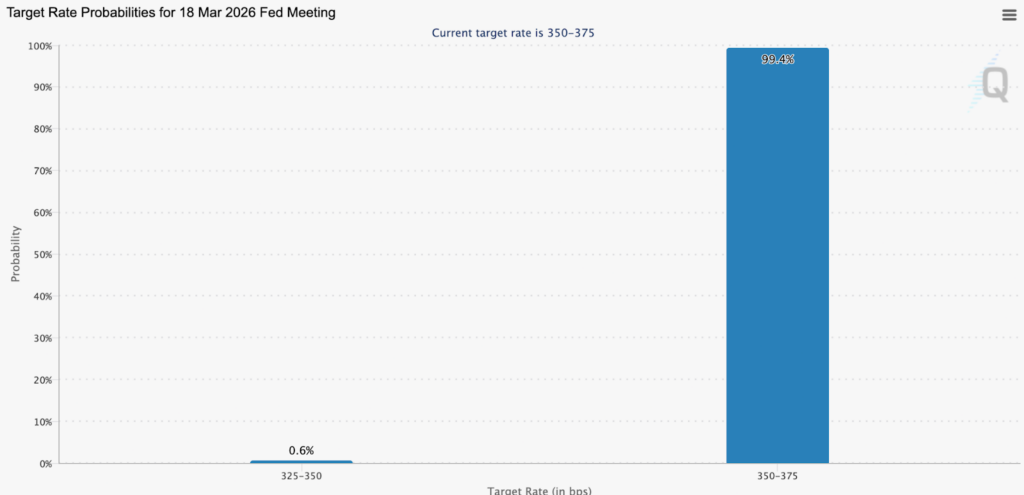
At the time of writing, the odds that the Fed maintains rates at 3.50% – 3.75% in the upcoming meeting next week stands at 99.4%, meaning markets have already priced this in. That said, as the macro backdrop has changed significantly since last month, the reason for that pause is becoming very complicated. On paper, the CPI reading could strengthen the argument for easing later this year if inflation continues to cool. A lower than expected reading of around 2.4% or below would add credibility to the thesis that disinflation is happening and could push markets to earlier rate cuts this year and prove to be bullish for risk assets, at least in the short term. However, as the Fed will be looking at inflation data collected before the energy shock, this leaves policymakers stuck between contradictory signals.
The situation may become even more complicated for the Fed if the CPI comes in hotter than expected. A reading above 2.5% would mean that inflationary pressures were already building before the oil spikes even entered the data. This will raise uncertainty around the fact that the March and April reports could come in significantly higher. Such a reading would immediately be seen as bearish for markets as the narrative could quickly shift from future rate cuts to a new inflation cycle.
Policymakers will need to explain whether they see the oil shock as inflationary, which would pressure risk assets, or deflationary through demand destruction, which could justify a more dovish stance. There is historical precedent for data lagging reality, during early 2020, CPI data lagged the economic collapse caused by COVID shutdowns by several months, prompting the Fed to act aggressively before the numbers caught up. Today, however, the Fed cannot move as quickly because inflation remains above target. The lag between an oil spike and its impact on CPI means policymakers may not see the full inflationary effects until the April or May reports, even as the economic consequences begin to show up immediately.
Bitcoin Already Priced the Shock: Equities Haven’t
At this stage of the conflict, Bitcoin seems to have absorbed the geopolitical shock even as traditional equity markets haven’t. When tensions around the U.S. Iran first flared up in early February, Bitcoin dropped to a low of $60K before reversing to the $70K region. Since the start of the conflict on February 28, Bitcoin is up over 6% while the S&P 500 is down -1% at the time of writing. Other global indices like South Korea’s Kopsi and Japan’s Nikkei have underperformed a lot more. At the same time, the VIX rose above 35, a level that has historically shown to coincide with periods of market panic and local bottoms for BTC. This pattern suggests that Bitcoin might have already witnessed its steepest risk off phase while equities continue to reprice and digest the macro shock.
Despite Bitcoin holding up relatively strong so far, today’s CPI print is the short term trigger. Research from GoinGecko states that lower than expected readings have on average resulted in Bitcoin rallying roughly 1.2% within 24 hours, while higher readings tend to bring mild declines of around -0.8% but that the reaction has become more sensitive and stronger since the launch of Spot ETFs.
That makes the current setup unusually asymmetric: a cool CPI could trigger a classic risk-on bounce, while a hotter reading strengthens the stagflation narrative, an environment where Bitcoin has historically outperformed equities because it sits outside the traditional policy framework that governments use to manage economic crises.
What to Watch After the Print: March 18 FOMC is the Real Event
In the short term, traders will be keeping a close eye on how BTC performs hours after the CPI data comes out. A cool print will likely be bullish for Bitcoin and we could see Bitcoin once again retesting yesterday’s highs of close to $72K. This would strengthen the decoupling narrative that started earlier this week. A hotter than expected print however could send BTC to retest the $67K zone and would shift attention to the crucial $65K level.
Beyond the immediate reaction, markets will closely watch comments from Fed officials leading up to the March 18 FOMC meeting. While the odds of a rate cut are miniscule, what will matter more than the rate decision itself is the updated dot plot, economic projections and, Fed chair, Jerome Powell’s tone and any hints on whether the oil shock delays or accelerates rate cuts.
]]>Given that these companies possess transformational technologies, massive addressable markets, and structural growth tailwinds, once they go public, early investors will have the opportunity to potentially cash in a fortune. Those beneficiaries include VC funds, private equity, and accredited investors.
What about retail investors? Well, they are just not allowed to invest in these high-value private companies, not before they have gone public and valuations have already matured.
That’s right. These promising private market opportunities are only reserved for billion-dollar funds, institutions and ultra-wealthy individuals. Besides exclusivity, such ventures require high minimum investments, which are often locked in for years.
Together, these factors make private equity, one of the world’s best-performing asset classes, inaccessible to a regular individual. But not anymore.
Tessera is challenging the norm with its open, global, and verified private equity exposure.
The decentralized private-markets platform now lets everyday investors gain exposure to the world’s most valuable private companies.
The idea is to bring lower volatility, high growth potential, and high returns of private markets to a transparent, liquid, and borderless system, in which absolutely anyone can participate, regardless of their income level or net worth.
A New Financial Layer for Global Investors
Private equity is one of the largest asset classes in global finance, holding ownership in many of the companies shaping the modern world.
To build a future where capital markets are open by design, Tessera is bringing private equity exposure on-chain. Using the tokenized structure, Tessera is unlocking a new financial layer where anyone can participate permissionlessly with just a wallet and as little as one dollar.
With this permissionless token approach, Tessera removes the need for KYC requirements while enabling DeFi composability that will drive the next wave of on-chain innovation.
Each private asset exposure, held within a legally structured, segregated portfolio, is tradable 24/7, enabling real-time price discovery rather than quarterly valuations. This ensures continuous liquidity, thus improving capital efficiency.
Every asset backing is also auditable on-chain through Chainlink Proof of Reserves, so anyone can verify that tokens in circulation match the assets held in portfolios.
To launch new assets on Solana-based Tessera, the platform uses fair distribution mechanisms powered by Meteora’s Alpha Vault. Participants deposit funds during a defined auction window, and allocations are handled transparently according to preset rules. This structure removes gas wars, reduces front-running risk, and ensures a level playing field for all participants.
When these private companies eventually have their liquidity event in the form of an IPO, acquisition, secondary sale, or an equivalent corporate action, the underlying exposure is liquidated, and participants can claim their share in stablecoins.
For security, Tessera utilizes the military-grade cryptographic system of Fireblocks, a platform used by financial institutions for secure token minting, transfers, and burning.
With Tessera, retail participants gain access to promising private companies through a transparent, tokenized structure. As new private equity opportunities are sourced and listed, the platform’s catalog expands, increasing choice and liquidity for participants. Tessera plans to continue introducing additional tokenized offerings over time, giving users greater ability to diversify exposure, manage risk, and align their portfolios with their individual financial objectives.
Tokenized Access to the World’s Most Valuable Companies
Tokenization is the leading and most profitable crypto narrative, which has captured the interest of banks, asset managers, institutions, and governments all over the world.
Projected to be worth trillions of dollars, so far the tokenization of real-world assets (RWAs) has grown past $25 billion primarily across US Treasury debt, commodities, private credit, corporate bonds, and public equity.
To democratize private markets, Chan Ahn has built Tessera. Leveraging his two decades of experience in financial markets, he is now bridging private market access with public market liquidity to unlock transformative opportunities for investors.
While working at leading institutions such as Goldman Sachs, JPMorgan Chase, and Credit Suisse, Ahn experienced firsthand the limitations of legacy financial infrastructure, including paper settlement and closed distribution.
To overcome these constraints, Tessera is utilizing stablecoin rails that enable near-instant settlement. By lending USDT or USDC, participants receive Tessera Tokens, which are tied to high-growth, high-impact private company exposure.
A tokenized exposure to SpaceX has already been launched on Tessera, in February 2026, raising $279,000 in an oversubscribed auction in just six hours.
Notably, Tessera tokens are liquid from day one and can be freely transferred between wallets. They are fully compatible with Solana DeFi infrastructure, enabling users to trade on DEXs, provide liquidity to earn fees, and participate in lending and borrowing protocols.
Tessera is challenging the age-old model of private equity, which has been reserved for a privileged few. By combining tokenization, DeFi composability, institutional-grade security, and transparent on-chain verification, it is turning private market exposure into something liquid, auditable, and globally accessible.
Positioned at the intersection of trillion-dollar innovation companies and a fast-growing tokenized asset ecosystem, Tessera is not just offering new investment products but redesigning how capital markets function. In doing so, it opens one of the largest asset classes in finance to those who have historically been locked out, reshaping private equity from an elite privilege into an open financial layer for the world.
This article is provided for informational purposes only and does not constitute financial, investment, legal, or tax advice. Participation in private market exposure involves significant risk, including the potential loss of capital. Prospective participants should conduct their own independent research and consult with qualified professional advisors before making any financial decisions. For complete terms, conditions, eligibility requirements, and risk disclosures, please refer to the official documentation at tessera.pe/terms.
This was the first indication of a genuine decoupling taking place during the crisis, and not for the reason many expected. BTC did not hold up despite being a risk asset; it held up because the United States is uniquely insulated from this particular oil shock. The U.S. imports only a small portion of its crude from the Middle East and is now the world’s largest net exporter of oil, thus making its economy far less sensitive to the geopolitical supply disruption shaking the rest of the world. As a result, Bitcoin, which is increasingly tied to the U.S. financial system through ETFs and institutional flows, behaved less like digital gold and more like a quasi-U.S. macro asset.
Oil Just Had Its Wildest Day Since 2020 and Bitcoin Ignored It
The volatility seen in oil markets yesterday was something not seen in years. As fears of further disruptions in the Strait of Hormuz intensified, WTI crude rose above the $115 mark to reach a high of $119 per barrel, the highest level since June 2022. This rally, however, reversed just as quickly as it started after President Donald Trump told CBS that the Iran war was “very complete, pretty much”, hinting that the hostilities might soon be coming to an end. Oil prices plummeted back toward the $85 range within hours, producing an intraday swing of over $30, a move not since 2020.
Another factor that added to the shift in sentiment was news that G7 nations were discussing the possibility of releasing emergency oil reserves in coordination with the International Energy Agency. That said, the reality is that oil flows through the Strait of Hormuz remain at a standstill with tanker traffic hovering near zero. This shock has already seeped into gasoline prices across the U.S. with the national average now at 3.53, up 13.8% since last week.
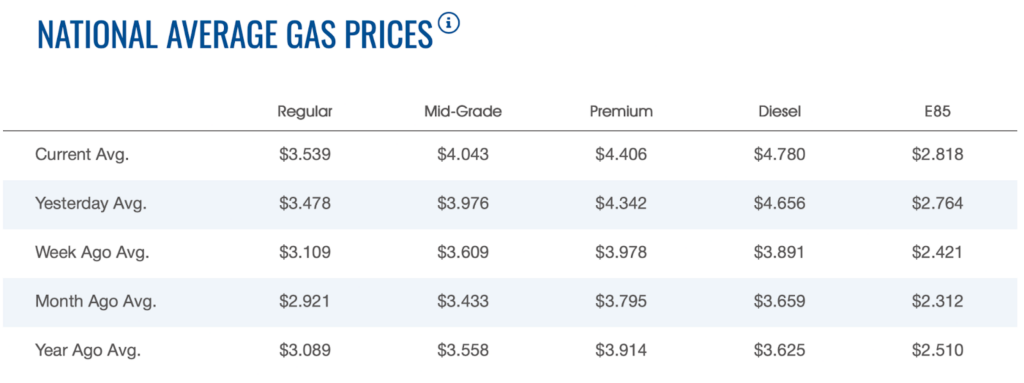
Despite this macro backdrop, Bitcoin moved in the opposite direction. It climbed by 3.73%, opening the day at $65,970 and rallying all the way to a high of $69,543, outperforming traditional indices like the S&P 500 and the largest stock markets across Asia. Analysts at QCP Capital noted that while Bitcoin may not have fully earned its “digital gold” label yet, its role as a “digital escape hatch” is becoming increasingly relevant, particularly for capital in the Gulf region navigating geopolitical and financial uncertainty.
The US Is Insulated From This Oil Shock and That’s Why Bitcoin Held
A key reason for why Bitcoin has held up so well during the crisis so far might actually be less to do with crypto itself and more to do with the structure of the global energy market. As analysts from JP Morgan state, “the United States is not meaningfully exposed to oil from Iran, or, more broadly, the Middle East.” Majority of the imports are from Canada and Mexico with only 4% coming from Saudi Arabia while becoming the world’s largest net exporter thanks to the shale boom and rising domestic production. This relative level of isolation means that the immediate economic damage is far less severe in the U.S. compared to many other regions.
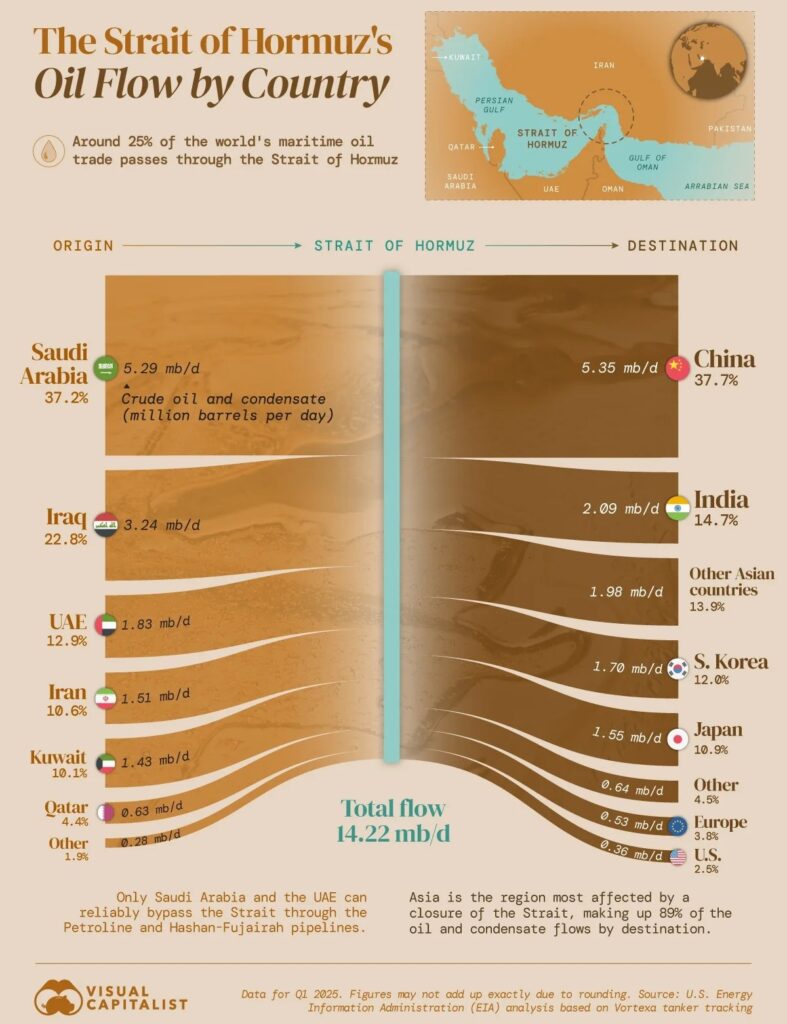
Source: Visual Capitalist
Oil dependency on the Strait of Hormuz and the performance of countries’ main stock indices seem to be highly correlated right now. Asian economies that are far more dependent on energy flows from the Middle East have taken the largest hits since the conflict erupted on February 28. For instance, since the start of the war, South Korea’s Kospi is down over -10%, Japan’s Nikkei dropped roughly -5% and India’s Nifty falling around -3.5%, while the S&P 500 is down only about -1.23%. Bitcoin, meanwhile, has outperformed all these major indices and is currently up over +6% since hostilities began.
The reason lies in how Bitcoin now trades. Since the Bitcoin Spot ETFs went live over two years ago, BTC has increasingly behaved like a quasi-U.S. risk asset, moving alongside Wall Street, U.S. tech stocks, and dollar liquidity. Institutional access via these ETFs has effectively tethered Bitcoin to U.S. capital flows, meaning it benefitted from the same relative insulation that has so far protected American markets. Having said that, as the on ground situation of the conflict is still developing, this insulation may not last forever. JP Morgan also cautions that if the war continues to drag on, higher oil prices could very likely feed into U.S. inflation and consumer costs. This means the protection that the market is seeing today could very well be temporary.
Every VIX Spike Above 30 Since 2023 Has Marked Bitcoin’s Bottom
The CBOA Volatility Index (VIX) rose above 35 on Monday for the first time in nearly a year, indicating panic across traditional markets. Looking back, these spikes in the VIX have often correlated quite closely with Bitcoin market bottoms. During the Silicon Valley Bank crisis in March 2023, the VIX rose above 30 as BTC bottomed near $20,000. In August 2024, the unwind of the yen carry trade pushed the VIX above 64, with Bitcoin finding support around $49,000. The pattern repeated in April 2025, when tariff turmoil sent the VIX near 60 and BTC bottomed around $75,000. Now with the Iran war and the resultant oil shock pushing the VIX above 35 and Bitcoin rallying past $70K, an inflection point might be forming.
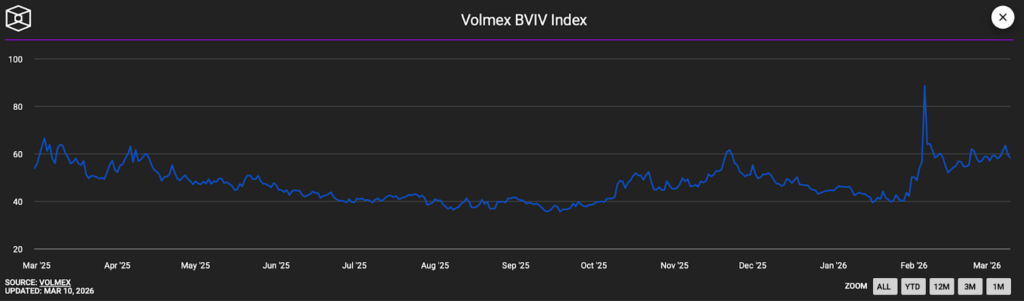
The logic behind this pattern is pretty straightforward. A VIX spike means peak panic in traditional markets, while Bitcoin, trading 24/7 with deep liquidity, often front-runs the capitulation phase. In fact, when we look at BTC’s own volatility gauge, the Volmex Implied Volatility Index (BVIV), it appears to have absorbed much of the stress earlier. The BVIV skyrocketed to 88.54 in early February when Bitcoin hit a low of $60K but has since cooled to 58.02, hinting at the possibility that Bitcoin’s peak panic phase may already be behind even as TradFi volatility goes up.
Contrarian signals continue to stack up. The crypto fear and greed index is at extreme fear levels, funding rates across major alts remain negative and the Bitcoin network has just crossed a historic milestone with the 20 millionth Bitcoin mined, putting 95.2% of the total 21 million now in circulation. With the remaining one million BTC set to be mined slowly over the next century and spot ETFs already holding tens of billions of dollars worth of coins, the market now finds itself in a rare setup where maximum scarcity is colliding with maximum fear.
CPI Wednesday, FOMC March 18: What Breaks the Pattern
The first major catalyst that could likely decide directionality for BTC is going to be the U.S. CPI report that comes out on Thursday, March 12. This will be the final inflation reading before the Fed meets next week. If the brief oil spike feeds into inflation data, it could reinforce the stagflation narrative now hanging over markets. But if CPI largely reflects pre-shock energy prices, markets may interpret it as a relief signal
The focus is then on the FOMC meeting on March 18. While the odds of maintaining rates are overwhelmingly high at 97.3%, what matters here is the tone and language used at the press conference. If policymakers frame the oil shock as deflationary through demand destruction rather than inflationary, it could be bullish for risk assets, including Bitcoin.
Apart from these macroeconomic events, oil itself remains the biggest swing factor. If disruptions in the Strait of Hormuz come to a halt, oil prices could fall quickly and remove the inflation threat. On the other hand, if Trump’s “war is over” rhetoric proves to be premature and strikes resume, this could very likely lead to spikes in oil prices and bring in a lot more uncertainty across markets.
]]>